


For the past four years I’ve helped to produce the South Fayette STEAM Innovation Summer Institute. This year’s two week set of workshops were extremely well received by educators and students who attended. Close to 98% of the participants gave a 4 or 5 to the workshop instructors and 99% for the organization of the sessions. Here’s a quick look at just five of the fifteen workshops that happened with quotations from the participants:
Python
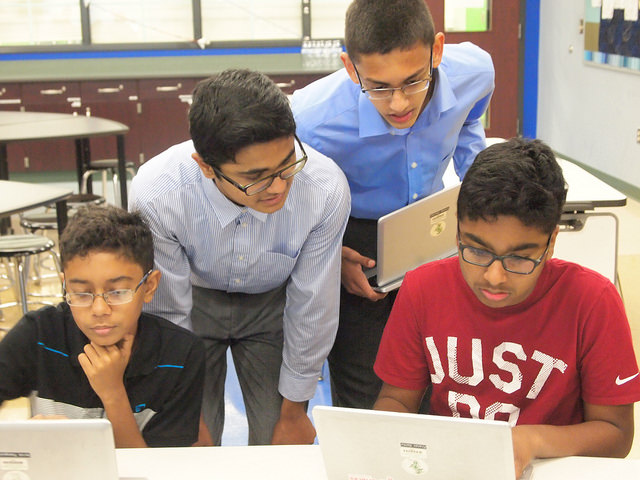
Aileen Owens, the Director of Technology and Innovation for the South Fayette School District and the Coordinator for the Summer Institute, gathered together a team of South Fayette students to co-teach a four-day workshop. The students worked with Carnegie Mellon University graduate and faculty members to develop a course for 8th grade students. The summer workshop provided an opportunity not only for the students to teach, but also for other students to test out the course along with several teachers from around the Pittsburgh region. The course includes a variety of activities that incorporate the Finch robot as part of a unit based on the novel and movie, The Martian. Both students and educators enjoyed the opportunity to test out this new beta course. One the teachers commented, “I will be teaching a coding course this upcoming school year and this course exposed to me Python for the first time. It also gave an insight into what the kids would be doing in a course, how they learn the software, what intrigues them in the coding world and how they adapt to the new language they are learning.”
Scratch Programming
Shad Wachter, the STEAM teacher for South Fayette’s Intermediate School, shared his talents for the fourth time this summer. Shad shared his years of experience working with Scratch for a team of educators who ranged from beginners to experienced teachers. At South Fayette everything fits into a computational framework. Shad constantly provided stories from his classes on how sets Scratch and the classroom experiences part of a larger context that includes the ability to problem-solve, develop algorithms, find repeating patterns, and use coding as part of other tools, such as BlocksCAD, a free kids-focused graphics program. According to one of the educators, “Everything was new! If I begin working at an intermediate or middle school, I can absolutely see fitting Scratch into the curriculum to introduce computational thinking!
Join the Maker Movement

Building Sustainable Mindsets
For the first time South Fayette partnered with Chatham University’s Eden Hall Campus. According to the Summer Institute program: Topics in sustainability have great potential to help integrate across the disciplines while providing fodder for meaningful, student-driven projects in schools and communities. This workshop will introduce participants to mindsets and topics in sustainability, including: food systems and access, biodiversity, green buildings and schools, air quality, renewable energy, aquaponics, vertical gardening, community development, systems thinking and ecoliteracy. For the session participants used a Project Based Learning (PBL) framework to begin planning units to encourage students to take action in their schools and communities. The participants were quite enthused by their experiences in Sustainability and PBL. One of the educators indicated how well the two themes wove into her work, “My job is mostly project based so this helped me think about sustainability for my program.”
STEAM Innovation
