
In May 2024 I joined nine other CoSN delegates from the United States and Australia in Spain to look at the world of digital learning with a focus on AI in Education. The group visited schools, engaged in conversation with the Ministry of Education in Barcelona and Madrid, had meetings with educational technology startups, and attended the GEF Global Education Forum in Madrid. To share out their findings the group participated in a streaming video presentation in Madrid with key educational leaders in Spain. In the spirit of the subject, this article is an AI generated summary from the Spain simulcast on May 8, 2024 with some edits on my part to clarify names and roles of participants.
According to Keith Krueger, the Executive Director for CoSN, the conversation for the trip highlighted the sustainability of investments in education and infrastructure, and the potential of artificial intelligence in education. Carlos Medina from the Spanish Ministry of Education provided insights on their digital education strategy, highlighting a significant investment of €1 billion over the years to equip all classrooms in Spain and close the digital divide by providing devices to students. He also shared that they have invested €300 million in a digital school plan for all schools in Spain and aim to certify the digital competence of 560,000 teachers in the next year.

Stuart Mitchell, the General Manager of Assessment Systems and Data Standards for the Australian company, Education Services Australia Ltd, highlighted the differences between the EU’s focus on digital competencies and AI in schools, and Australia’s current focus on AI. He noted concerns about the unregulated use of AI and the impact on privacy and data security. The discussion also touched on the challenges of ensuring data privacy and security in various jurisdictions, with Australia’s diverse regulatory landscape being mentioned. Stewart emphasized the importance of sharing perspectives and learning from each other’s experiences, pointing out that unique approaches can lead to valuable insights. The conversation also touched on the potential of AI to inhibit innovation if not regulated properly.
Cindy Bingham, a retired executive director of tech services, and Emmanuel Ajanama, a representative from the Barre Unified School District in Vermont, shared their observations of the European Union’s funding and support for school infrastructure and tech services. Cindy noted that private schools in Texas, like their own, had to find their own funding for network infrastructure. Cindy found it interesting that in Spain, the regional government provided funding and support for tech services, and she wondered about the expertise and structure of this support. Diana Hawari, the CIO for the Dysart Unified School District in Arizona, explained that her district had a tech team and a digital coordinator for on-site support. Laurel Bingham, a former teacher and now a community programs coordinator for the Jackson Hole Children’s Museum, shared her experiences with teacher networks for support and professional development. They all agreed that collaboration and sharing of knowledge and resources among schools and regions could lead to better integration and support for students.
Laurel emphasized the importance of a pedagogical approach to learning, highlighting the value of experiential learning in place-based settings, combined with interdisciplinary activities. She also stressed the role of technology in enhancing student engagement and learning. Laurel pointed out the necessity of not forgetting the basics, like numeracy and the understanding of physical concepts, even with the help of AI. She also expressed her views on the future of education, stressing the importance of encouraging and supporting students in asking questions and maintaining their curiosity.
Lastly, Keith introduced me, Norton Gusky, the former Coordinator Educational Technology for the Fox Chapel Area School district. I shared my experiences and impressions with a focus on digital literacy and the need for standardized learning paths across the country using a digital learning framework that incorporated computational thinking.

Carla Wade, the Senior Director of External Relations for CoSN, attended and spoke about the fifth edition of the Global Education Forum, which focused on artificial intelligence (AI). She highlighted the potential opportunities and risks of AI, emphasizing the need for institutions to adopt a strategic approach to its implementation. Carla praised the conference’s realistic and nuanced approach to AI, which integrated the technology into discussions and demonstrated its strengths and limitations. She also noted the importance of considering the impact of AI on humanity, and the need to surface, teach, and assess important human qualities. Finally, she compared and contrasted the education systems in Spain and the US, noting the latter’s emphasis on command and control compared to Spain’s more collaborative and incentive-based system.
Nevis Segovia, the founder and president of SEK, discussed the vision and outcomes of a recent conference on AI. The aim of the conference, which was attended by individuals from various sectors of the learning ecosystem, was to stimulate personal conversations that would lead to new insights and ways of thinking. Nevis highlighted that the conference was about challenging existing systems and promoting radical thinking, with the goal of transforming education. She also emphasized the importance of collaboration in advancing education, especially in the context of AI.

Final Thoughts: Digital Competency Framework
The European Commission in 2023 set out to address the digital skills gap and create a framework for the members of the European Union. Each country then looked at their internal issues and adapted the framework to their needs. The framework has five key components:
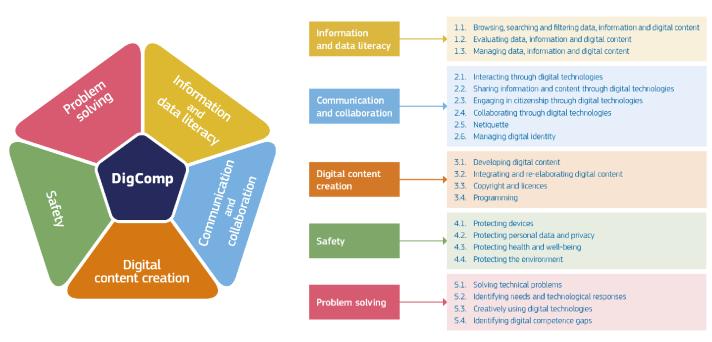
In Spain each of the 17 provinces then created their own version of the European model. The framework recognizes Artificial Intelligence (AI) and Computational Thinking (CT), but does not clearly define where they fit into the framework. Even though the framework was intended to address the needs for new jobs and careers for the citizens of Europe, there is no strategy embedded into the document. When I recognized these gaps I reached out to Albert Higuero, teaching technician, Educational Programming and Robotics Team, Digital Culture Area, Department of Education for Catalonia, Spain. Albert and I met at the Ministry of Education. When I realized there was a gap that my colleague, Aileen Owens, could address through her Computational Thinking Pathway developed when she was the Director of Innovation for the South Fayette School District, I put Albert and Aileen in touch. Aileen’s model became part of a National Science Foundation project for the Digital Promise. Six school districts across the United States adapted Aileen’s CT model that incorporated AI and the Future of Work. Today Aileen and I are working the Quakertown School District outside of Philadelphia to implement a new version of her model for Computational Thinking.
According to Albert Higuero from the Catalonia Ministry of Education, “… educational policy in Spain is complex because educational responsibilities are largely transferred to the regions (here we call them autonomous communities). Although there is a common minimum regulatory framework for the entire territory (LOMLOE), each region adapts it and establishes its own regulations. In the case of Catalonia, it is the LEC (2020 update).
In the next few weeks I’ll join my colleague, Aileen Owens, Quinn Burke from the Digital Promise, Albert Hugeuro and his team from the Ministry of Education in Barcelona, to discuss possible ways to collaborate. I’m hoping that we’ll be able to discuss the opportunity from a national perspective and then test out our ideas with the Sagrada Familia Primary School in Barcelona and one of Quakertown’s Elementary sites.
The trip to Spain as a CoSN delegate opened up a new door of opportunity for me. I’ve always believed in the important of global collaboration and this potential project could help both schools in the United States and Spain. Most importantly it will provide an opportunity for a conversation to look at the role of AI in Education as well as the Future of Work across the globe. I hope by next year to share the impact of this collaboration that will merge the Catalan framework for Digital Skills Competency with the Computational Thinking Pathway created by Aileen Owens for the Digital Promise.


Leave a Reply