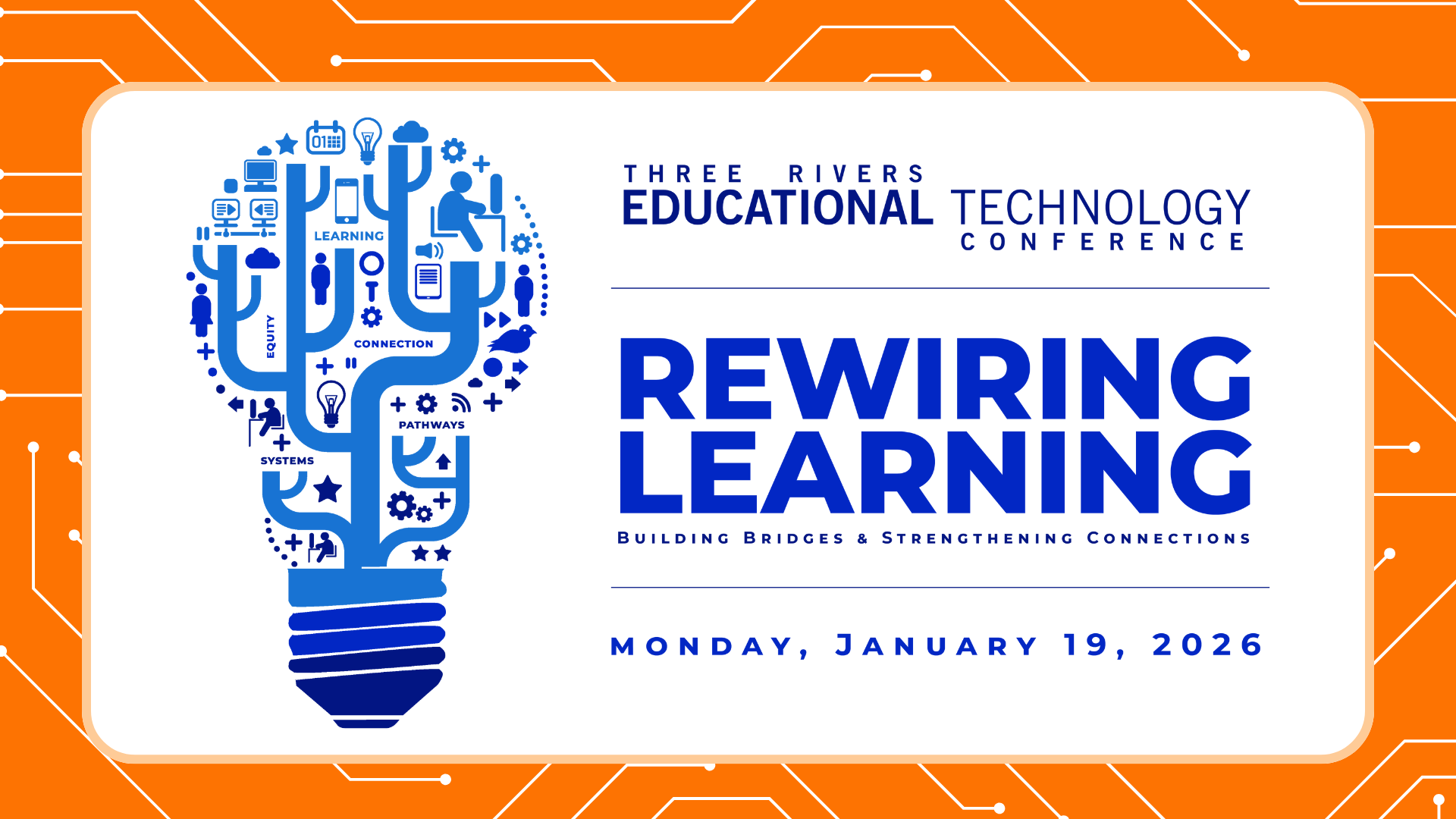
Marie Pelloni, Sr. Director, Talent and Workforce Development Initiatives at Pittsburgh Technology Council and Fortyx80, opened the full day session for the Three Rivers Educational Technology Conference (TRETC) on January 19, 2026 at Dorseyville Middle School by referencing the influence of Martin Luther King:
Today, as we honor Martin Luther King Jr., I’m reminded of his 1947 article, The Purpose of Education. In it, he wrote, “Education must enable one to sift and weigh evidence, to discern the true from the false, the real from the unreal, and the facts from the fiction.”
As we face the rapid rise of AI, computational thinking, and quantum computing, King’s words resonate deeply. Looking out at this audience, I’m inspired by your commitment to preparing students for “what’s next.”
This year’s TRETC kicked off with a great Keynote by Jeff Remington, the STEM Outreach Liaison for the Penn State Center for Science and the Schools (CSATS). Jeff shared his 35 years of teaching experience with the audience and explained where Artificial Intelligence (AI) has a role to play as long as we look at the long-terms gains, not the short-term benefits. Then the 600+ crowd of students, educators, administrators, community and business partners joined a series of workshops, sessions, conversations, and meetups.

Student Involvement
What made this year’s TRETC so special for me was the greater involvement of middle and high school students. Here are just a few of the many ways students were part of the conference. One of the Fox Chapel Area High School students interviewed people during the day using a podcast setup from Fluxspace, a corporate sponsor for the event. Chuck Trautwein, a long-term colleague, brought three young women on a journey over 2 hours from Garrett County, Maryland to discuss how they’ve become student leaders as part of a Youth Robotics Program working with younger students not just in their own county, but in West Virginia and Pennsylvania. In the gymnasium with the exhibitors the Industrial Arts Workshop program in Pittsburgh highlighted sculptures that students had welded. As part of the Student Showcase the Upper Saint Clair School District had two full teams of young women sharing their FIRST Robotics experience. And Neighborhood Learning Alliance’ Executive Director, Kashif Henderson, brought a team of students including an alumnus, Brett Searcy, a former teaching assistant for the High School University (HSU) program, who shared her insights into STEM at a session for educators:
“With no blueprint to guide me in STEM, I navigated the journey through trial and tribulation. Along the way, I discovered that patience and perseverance are the most powerful tools one can have.”
Educators in Action: Best Practices

TRETC attempts to share a wide-variety of best practices for all educators and administrators. I’ll just highlight a few sessions that either I had a chance to sample or my wonderful colleague, Zee Poerio, the K-8 Computer/Technology (STREAM) Teacher at St. Louise de Marillac Catholic School in Upper St. Clair, PA, shared on LinkedIn. Zee highlighted:
I have been a fan of Canva for years (It’s FREE for k-12, get your school or district verified. Do you have the BLUE ☑️? ) I use in with my students for projects including video clips and segments for our morning announcements, digital signage, posters, and today I learned about some of the newer AI features like creating a conversational Bot experience, designing a review Board game, build Interactive worksheets, teach with clickable infographics…. Thanks Sasha Aleksandra Goman and Dr. Rachelle Dené Poth for a very informative session with hands on time.
Lorraine Shaffer, the founder of Kid’s Innovation Playground, brought a team of Slippery Rock University students to demonstrate how to create a technology-rich space for after-school engagement. According to Lorraine, “So much fun presenting at TRETC with Slippery Rock University students Allison Peterson, and Stefanie Mounts @katie weiner! LOVED showing Tom Lauwers from BirdBrain Technologies a technology he had ever seen before!!!”
Kayleigh Gaborek, a special education teacher for the Start Up Success program for Pittsburgh Westinghouse Academy, looked at “Empowering Special Education Students through AI.” She then joined my session, “Future of Work: Are you Asking the Right Questions.”
Educators in Action: What Does the Research Say?
Often in the K-12 educational world people share their personal experiences but seldom do they have research that verifies their claims. Ed Hidalgo with the Educator’s Cooperative team enlisted independent researchers to look at their work around Career Connections. In the past year over 89,000 students were involved in conversations about Career Connections. At TRETC Ed shared the results of the research by introducing the participants to a Common Career Language, RIASEC, developed by John Holland over 40 years ago and a process that has been proven in schools across the United States. Michael Leasure, the acting high school principal and Special Education Director the River Valley School District, highlighted the Career Exploration successes for his district and also for the Elizabeth Forward School District where over 100 parents have recently been involved in the process. According to Kaleigh Gaborek, “I got some great ideas for how to use RIASEC during brain breaks. I am going to share this with my colleagues to help develop that common language of RIASEC throughout our school.”
Educators in Action: How Do We Rethink Policies?
Before this year TRETC never had a political leader join the conference. This year PA State Senator, Jay Costa, joined Audrey Russo, the President of the Pittsburgh Technology Council, for a fireside chat. Audrey and Senator Costa discussed recent educational technology initiatives and the lack of a state policy on AI in Education. Senator Costa highlighted that he doesn’t want to create a policy from the top-down, but he wants to listen and hear from education leaders on how policy-makers can craft legislation to provide guidelines and resources to help the K-20 world address the challenges of AI.
After the session I had a chance to talk with Senator Costa and Brian Kennedy, the Senior Vice President for Operations and Government Affairs for the Pittsburgh Technology Council. Look for TRETC 2027 at the Fox Chapel Area High School as an opportunity to interact with policy-makers to make future policy directions happen that will benefit learners and educators.
Wrap-Up
There’s so much I couldn’t experience at TRETC. I spent so much time networking and connecting people to other people. As I listened to participants there were amazing learning opportunities around Cybersecurity, a variety of AI sessions including a look at AI and the Law, eSports, reimagining high school, building engagement with a LEGO Brick based playground, using drones to engage learners, Makerspaces, Mechatronics, and a series of panels for Administrative Leaders. To learn more about all the things that happened at this year’s conference, check out the Digital Notebook. According to one of the administrative sessions the key is to “Start with the People, Not the Stuff.”

Leave a Reply