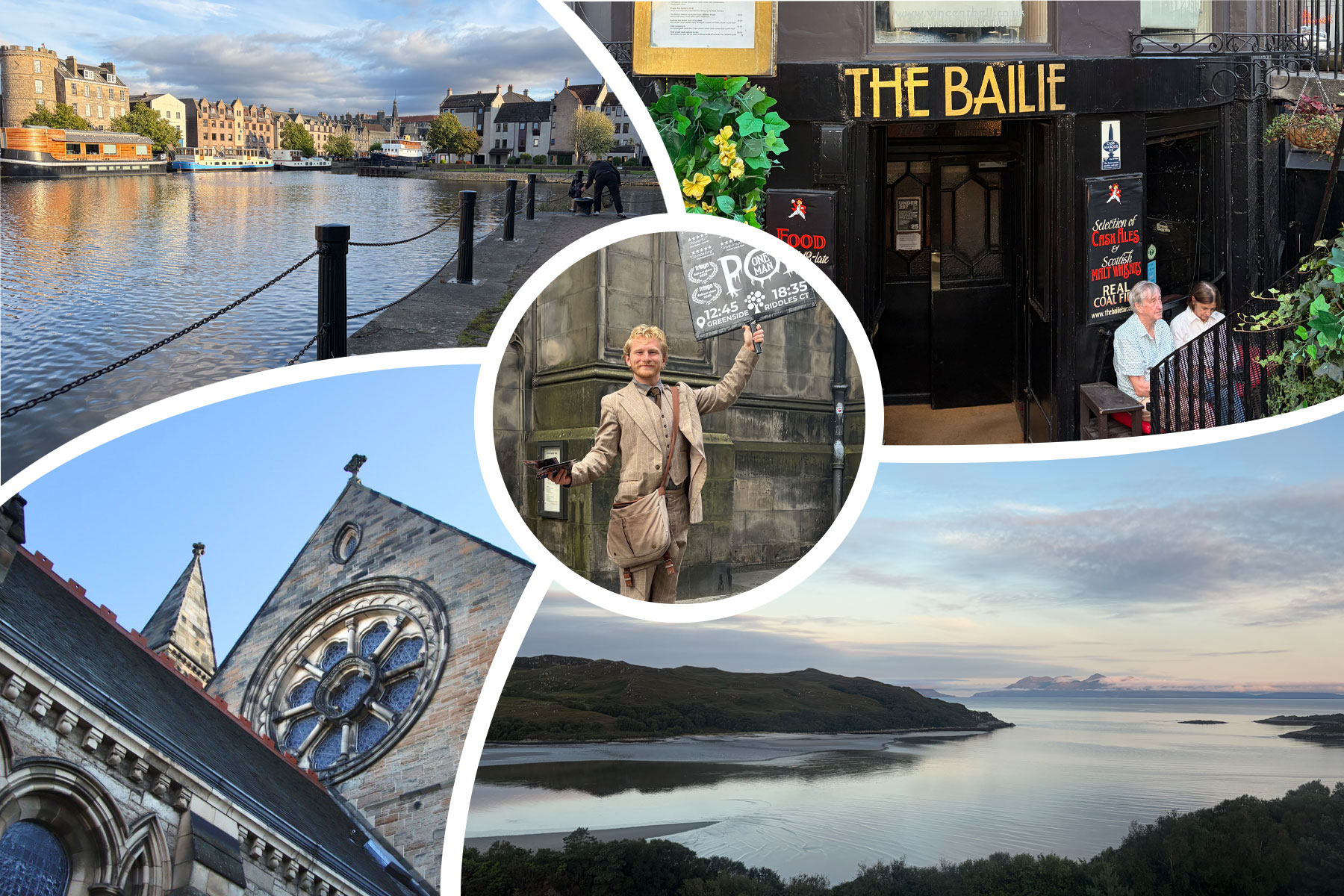
Where can you discover the best new works in film and theatre in one week? It’s Edinburgh, Scotland during the month of August. For a week I explored the wonderful city of Edinburgh and the Highlands leading to the Isle of Skye with my stepson, Jacob Dulberger. We discovered a beautiful country alive with the arts.
We made our way to Edinburgh to take in the Edinburgh International Film Festival (EIFF). Along the way we encountered fascinating people who were part of the Arts Scene in Edinburgh.
EIFF’s August fixture runs in parallel to a host of creative festivals taking place in Edinburgh, including The Fringe, Edinburgh International Festival, Edinburgh International Book Festival, Edinburgh International Art Festival, Edinburgh International TV Festival, and many more, which sell millions of tickets to cultural connoisseurs from around the world. In Edinburgh people have a chance to explore new works, to see new artists, to view new films that they wouldn’t see anywhere else.
Sowing Seeds: The Edinburgh International Film Festival
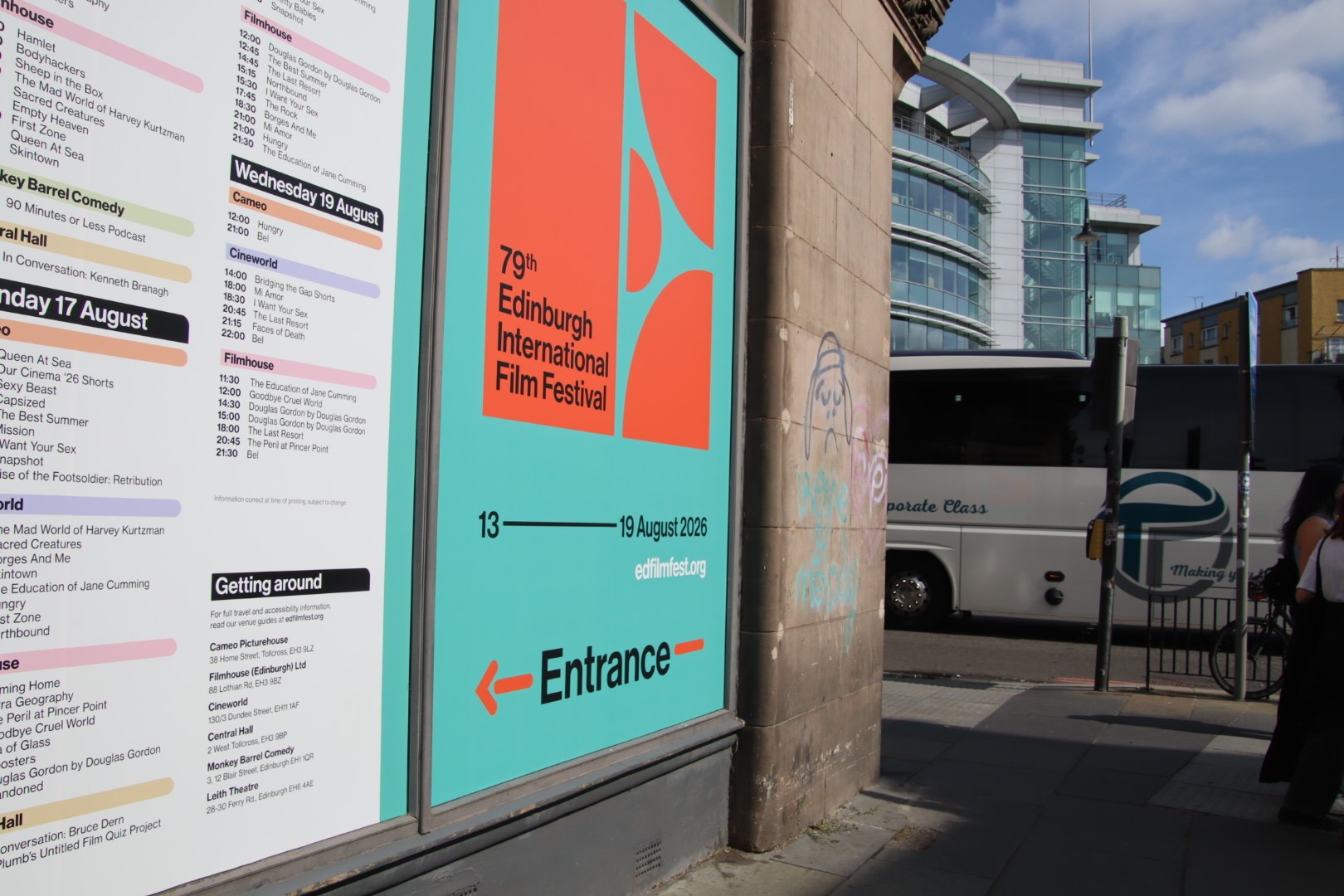
The EIFF started off as a documentary film festival in 1947. In 2024 it relaunched as a new entity showcasing (as the website declares): the very best filmmaking talent in a re-energised format that is rooted in a local Scottish context whilst embracing the international diversity of creative expression.
This year’s EIFF ran from August 13 to 19, 2026, celebrating the best of independent cinema with a program of 38 new feature films and 21 world premieres. A major highlight of the week was the 30th-anniversary celebration of a film that changed Scottish contemporary cinema, Trainspotting, featuring a live commentary event and an in-conversation session with star Ewan McGregor. The festival concluded its competitive track by awarding the prestigious £50,000 Sean Connery Prize for Feature Filmmaking Excellence to Kieron J. Walsh’s Northern Irish drama Skintown, while Sindha Agha’s Grief Room (a short I viewed) took home the Thelma Schoonmaker Prize for Short Filmmaking Excellence.
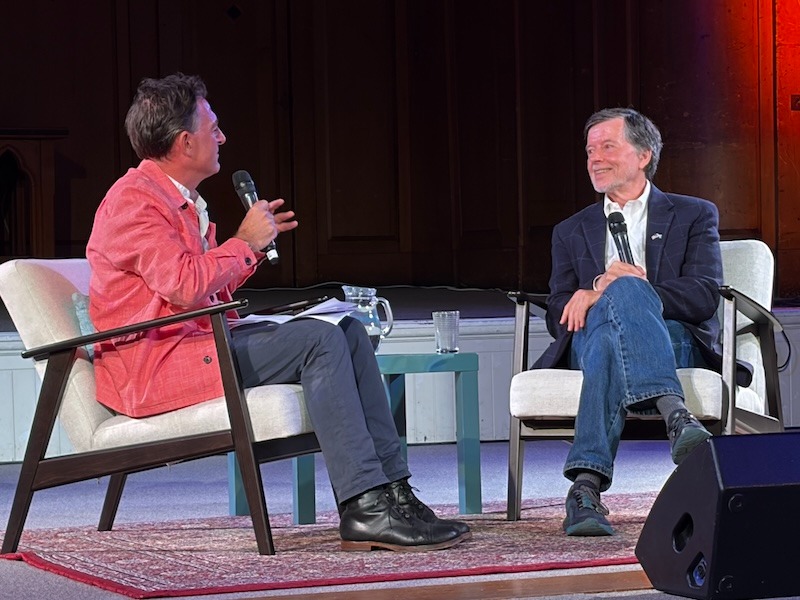
While I missed the opening and closing of the EIFF I had a chance to sample a variety of offerings at the four venues located in the West Side of Edinburgh. My first experience was something I’d dreamed about: interacting with Ken Burns, the legendary documentary filmmaker. The EIFF has a series called “In Conversation” where leading directors, actors, and people associated with a film share their insights with an audience. The session with Ken Burns highlighted his career starting with his first film, The Brooklyn Bridge, and leading to his new 12-hour series on PBS, The American Revolution. Ken Burns outlined his approach to filmmaking. He stated, “I wake the dead.” He explained that he tries to ask essential questions so people discuss the echoes, the rhymes to our history.
The festival showcased one of the latest episodes of The American Revolution. Ken Burns described it as the most significant project of his career, in which he aimed to deconstruct the “sanitized myth” of the nation’s founding and instead highlight a complex, violent civil war. In the film Burns used a variety of major characters like George Washington and John Adams as well as “minor” characters to highlight the complexity of the war – a Hessian soldier, an abolitionist, a female poet, a continental soldier, and an indigenous leader. Burns explained that history is messy and he tried to portray a variety of perspectives to paint the reality of the time and place.
At this year’s EIFF there were three blocks of shorts in addition to the feature films. I had a chance to view one block of ten short films. Luckily the block included this year’s award winner, Grief Room, directed by BAFTA-winner Sindha Agha. The 15-minute narrative follows three estranged sisters—played by Emily Beecham, Daisy Bevan, and Louisa Harland—who reunite at the deathbed of their formerly sharp-tongued mother who was now unconscious. Amid their shared grief and family friction, the youngest sister utilizes experimental AI technology designed to interpret their dying mother’s final thoughts, becoming obsessed with uncovering what she believes is an urgent, hidden message. Described by festival organizers as a “contained gem of wit, warmth and sadness,” the film explores with great humor how artificial intelligence and emergent technology are beginning to transform our most sensitive and deeply human experiences.
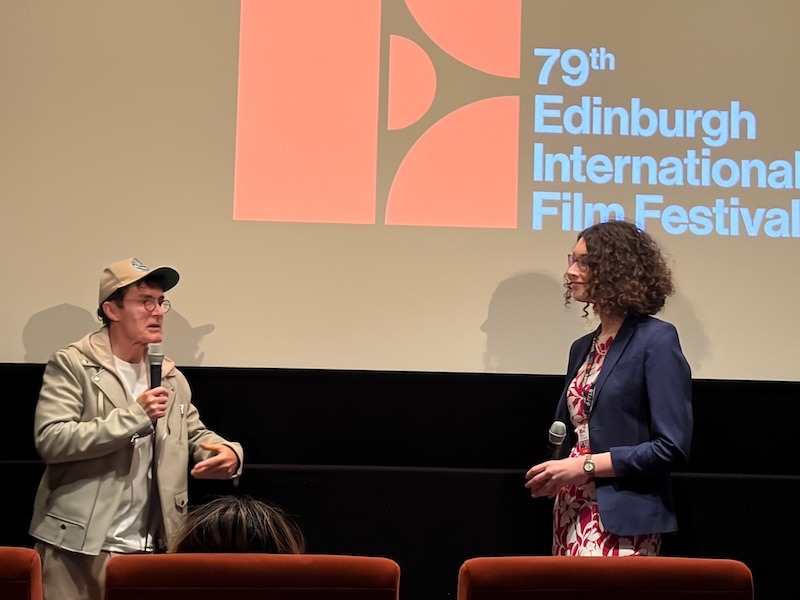
While Northbound directed by Walter Scoular didn’t win an award at the festival, it was my favorite film. One of the things I love about film festivals, like the EIFF, is the opportunity not only to see independent films but to meet the directors and the people who made the film possible. The film opened with a short video from Bruce Dern, the star of the film. Bruce was unable to attend the festival (he’s 87 and in poor health), but he wanted to share his thoughts about the film. Bruce explained that this was a film for everyone to see. It was a story that went beyond any bounds of age or nationality.
I agreed with Bruce. Walter Scoular crafted an outstanding road picture. Paul Ridd, the EIFF director described the film for the website:
Frustrated with living out his final days in a nursing home, elderly rogue Arthur (Dern) recruits his uptight grandson Kevin (Parrish) to break him out. Together the pair head north to Canada, picking up an enigmatic stranger (Fox) along the way. Acidly funny, unpredictable and ultimately very moving, this sharply directed and superbly acted film from director William Scoular is a showcase for Bruce Dern’s magnetic screen presence and feeling for a character who positively bursts off the screen. Featuring a final performance from legendary actor Graham Greene as well as superb supporting turns from Joanna Cassidy and Dylan Baker.
Film festivals are more than just watching a film. They’re an opportunity to understand the motivation for making a film. During the post-film discussion Walter Scoular explained why he created the film. It was loosely based on his father. He went on to share a very telling tale about his father who died last year in Canada. Walter’s father wanted to return to his homeland, Scotland, so Walter packed up his ashes and brought them to Edinburgh for the EIFF. Walter hiked up Arthur’s Seat, the mound overlooking the city, and tossed his father’s ashes into the sky, bringing him back to his Scottish homeland.
After the film I had a chance to talk with Carl Clifton, the man responsible for the distribution of the film. It was another great example of why I love to go to film festivals. It’s important to understand the business model for filmmaking. Northbound has not found an American distributor or streaming media partner. That means that the only way you can see the film is at a festival, like EIFF. I’ve been on the Board of the Pittsburgh International Film Festival and I’m always looking for films to bring to Pittsburgh. With luck, you may have a chance to see Northbound in November at the Three Rivers Film Festival.
Growing the Arts: The Fringe Festival
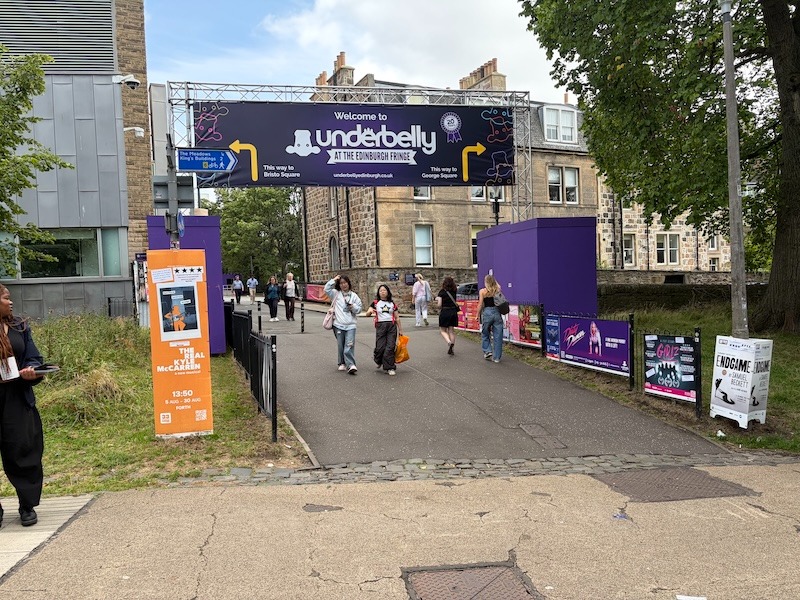
I think it’s amazing to realize how much can go on over a stretch of a month in one place with less than a million people living there. Edinburgh opens its doors and sells millions of tickets to a wide range of cultural festivals with the Fringe Festival as the largest draw. The festival has hundreds of locations across the city, mainly in the New Town and Old Town areas. I didn’t get to attend any of the shows, but I met a number of people who were at the festival and shared their stories.
On my return flight from Edinburgh to Pittsburgh I met a couple who had just spent a week at the Fringe Festival. It was not their first trip. This time they went to see their son, Jacob, perform on stage. However, Joe, the father, had a long track record on stage including performances when he was his son’s age. Joe got his start with Second City in Chicago, and considered the Fringe as one of the great opportunities to share his improvisational talents. When Joe heard I was from Pittsburgh, he asked me, “Did you see the CMU troupe at the Fringe with Tom Cruise’s daughter, Suri Noelle, performing? The show received great reviews.” I didn’t have a chance to catch any of their performances, but I decided I needed to follow this lead.
But somehow I walked right by the troupe at St. Andrew’s Square! I had dinner one night at a restaurant by the square and saw a stage, but I didn’t realize who was performing. The CMU troupe performed a contemporary version of Shakespeare’s A Midsummer Night’s Dream entitled Midsummer! The production was infused with classic comedy, Appalachian folk music, house beats, and reflecting the Steel City aesthetic, a steel factory.
Why was it important for CMU to take the production to Edinburgh, Scotland? Rich Ettinger, the Co-Artistic Director for New Work at CMU and one of the key production people with the troupe, explained:
There is truly nothing quite like the Edinburgh Festival Fringe. With MIDSUMMER!, our students moved beyond the traditional university production model and became part of an international community of thousands of artists making and sharing work simultaneously. They performed for audiences with no prior relationship to CMU, saw work from around the world, and experienced firsthand the incredible energy, rigor, and beautiful chaos of the Fringe.
What made this particularly special was that they arrived in Edinburgh having spent the summer developing a new piece alongside extraordinary professional artists. Tony Award-winning playwright Jeff Whitty was in residence with us throughout July and August, working directly with our students alongside director Kim Weild and choreographer Lucas Fedele. The students weren’t simply taking a finished CMU production overseas—they were participating in the development of new work and then sharing it on an international stage. That kind of experience is invaluable for young artists.
What makes Edinburgh so special? Edinburgh provides a stage for troupes like the CMU students to show their talents for a new work on an international stage with a large audience coming from all over the world. For filmmakers it’s an opportunity to show short films that provide the on-ramp for future filmmakers. For experienced directors, like Walter Scoular, it’s a chance to share a wonderful movie that doesn’t fit the format for today’s economic cinema model. It’s not a money-maker that can compete with Hollywood epics and it’s not on the radar of the streaming services. However, it’s a film that deserves an audience.Edinburgh provides that opportunity.



Leave a Reply